
India's ductile-iron (DI) pipes market was valued at USD 3.59 billion in 2025 and is forecast to reach USD 11.66 billion by 2035, at a 12.5% CAGR (Expert Market Research). The driver is policy capital: under AMRUT 2.0, 3,571 water-supply projects worth INR 1.18 trillion were approved by MoHUA as of August 2025 (Moglix Business), and the Union Cabinet has extended Jal Jeevan Mission to December 2028 (JJM 2.0) with a total outlay of INR 8.69 trillion (Market Research Future).
DI pipes are the preferred specification for AMRUT and JJM project schedules because of leak-proof jointing and corrosion resistance — and because the design life of an installed DI pipe exceeds a century. Major Indian DI pipe producers are seeing the order book reflect this. The metallurgical input that goes into making those pipes — Ferro Silicon Magnesium for the nodularisation that produces the ductile structure — is on a parallel growth curve.
What DI pipe foundries actually need from FeSiMg
Centrifugally cast ductile-iron pipe is one of the most demanding ductile-iron applications for nodulariser performance. The pour cycle is long, the wall thickness varies across diameter classes (K7, K8, K9, K12), the casting cools against a steel mould, and the customer specification is consistently audit-grade. Three FeSiMg attributes matter most:
- Mg recovery consistency — pipe-grade contracts run for months; the variability of Mg recovery batch-to-batch is what drives scrap rate. Calcium-bearing grades (BBMAG 380810, 630515) reduce flare in ladle treatment and improve recovery predictability.
- Rare-earth neutralisation of tramp elements — DI pipe foundries running recycled charge mixes pick up Sb, Pb, Bi and Ti. Lanthanum-bearing grades (BBMAG 630520 La, 630533 La) carry 0.4–0.6% La specifically to neutralise these.
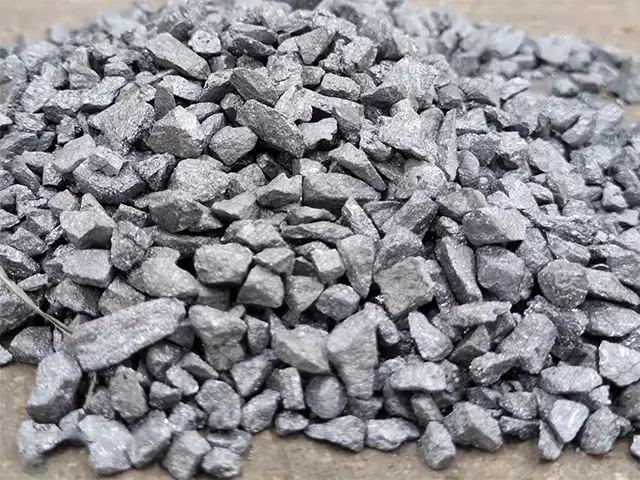
- Particle size matched to addition method — sandwich-pocket treatment wants 5–15 mm; cored-wire treatment wants 2–5 mm or finer. Both size bands are standard in the BBMAG range.
How the contract-level dynamics will read in 2026
DI pipe foundry contracts written through 2026 are likely to skew toward multi-month FeSiMg supply with tighter chemistry-tolerance bands than the general-purpose ductile-iron market has historically demanded. Three reasons: AMRUT and JJM project audits feed back into pipe supplier quality requirements; the financing structure of these projects rewards lower scrap rates; and the installed-pipe service life means failure cost compounds in ways the mid-stream contract owner cannot ignore. For ferro-alloy producers, the implication is the same as for PLI-tied stainless contracts — longer horizons, tighter Certificate of Analysis discipline, and customisation premium on chemistry rather than discount on price.
Producers with a broad BBMAG grade range and the metallurgical service depth to support foundry-side grade selection are positioned for this regime in a way commodity FeSi-Mg traders are not.