

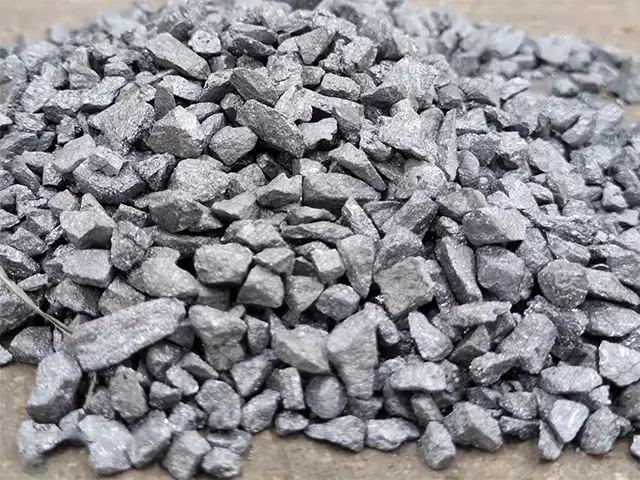
Ferro Silicon Magnesium
Precision-engineered nodularizers for molten iron treatment. We ensure superior graphite formation for ductile iron castings worldwide.
KEY APPLICATIONS
Key Features
Advanced Nodularisers for
Ductile Iron Production
Nodularization involves adding a magnesium treatment to molten base iron. Ferro Silicon Magnesium is the most versatile product for this process.
Our specialists provide expert knowledge to help you find the perfectly tailored composition for your specific metal treatment process.
We are a trusted supplier to global foundries.
Product Forms
Quality Assurance
Our Ferro Silicon Magnesium production is governed by strict ISO 9001 :2015 protocols, with meticulous monitoring from raw material to final packaging.
We utilize WD-XRF for rapid analysis during melting, ensuring tight control over Mg, RE, and Ca levels.
Final products undergo rigorous testing for chemical composition, size distribution, and reactivity to guarantee consistent foundry performance.
Infrastructure
Our facility houses multiple induction melting furnaces, providing flexibility for both large-scale orders and custom batches.
Automated casting and crushing lines ensure uniform product size and shape, minimizing fines and maximizing yield for our customers.
The production environment is equipped with advanced pollution control systems to maintain a safe and compliant operation.
Metallurgy
Ferro Silicon Magnesium acts as a potent nodulizer by introducing magnesium. This promotes the growth of graphite in a spheroidal (nodular) form instead of flakes.
The presence of Rare Earth Elements (RE) neutralizes the harmful effects of tramp elements, preventing graphite degeneration.
Calcium in the alloy controls the magnesium reaction, reducing flare and improving magnesium recovery for a more efficient process.
ISO 9001 :2015 CERTIFIED QUALITY SYSTEM
All production batches are tested in-house to ensure consistent chemical and metallurgical parameters.
Explore Other Products
Discover our full range of high-performance metallurgical solutions.
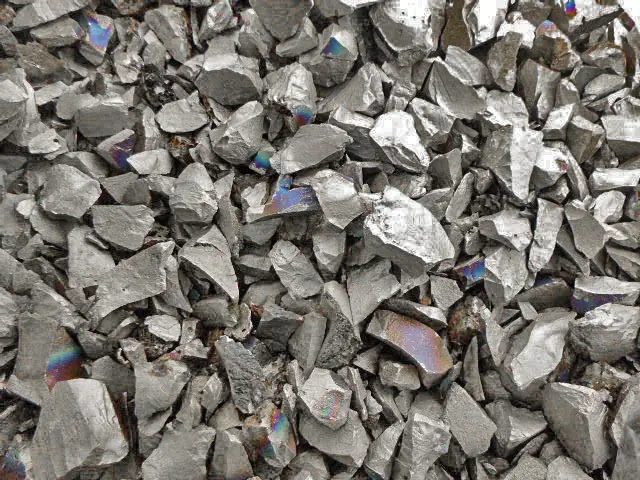

Applications by industry
How this alloy is used across the verticals we ship to in India and globally.
Automotive
Nodularises iron for crankshafts, knuckles, brackets and brake components in ductile-iron castings — key route to lighter, fatigue-resistant unsprung mass.
Agriculture
Hubs, gear-cases and tractor housings in SG iron benefit from the strength and machinability that consistent spheroidal graphite delivers.
Railways
Brake blocks, bogie components and pipe fittings rely on tight Mg recovery and low fade for service reliability under cyclic loading.
Wind
Hub, main-frame and bearing housings in large wind turbines are predominantly cast SG iron — Mg control determines fatigue life of these critical safety parts.
Water & Pipeline
Ductile-iron pipe and pipe-fittings (T-, K- and J-class) use FeSiMg-treated melts; magnesium recovery directly drives wall consistency and pressure rating.
Frequently asked questions
Common questions about Ferro Silicon Magnesium. For specification-grade enquiries, please request a technical sheet via the documents block above.
What does Ferro Silicon Magnesium do in foundry iron?
FeSiMg is the standard nodulariser for ductile iron. Magnesium introduced via FeSiMg changes graphite morphology from flakes to spheres (nodules), producing SG/ductile iron with much higher strength and ductility than grey iron.
What Mg ranges do you offer?
Our BBMAG range covers Mg from 3.5% up to 10% in twelve standard grades (e.g. BBMAG 630515 at 6.0–6.5% Mg, BBMAG 901010 at 9.0–9.5% Mg). Custom Mg, RE and Ca levels can be produced to spec.
Why are Calcium and Rare Earths in the alloy?
Calcium controls the Mg reaction — softer flare, better Mg recovery, less spatter. Rare Earths (Cerium-rich misch metal or La-rich) neutralise tramp elements like Pb, Sb and Ti that would otherwise degrade nodularity.
Which addition method do your grades suit?
Different grades are formulated for sandwich (open ladle), tundish-cover, plunging and cored-wire treatment. We help select the right Mg/RE/Ca balance and particle size based on melt temperature, ladle geometry and treatment route.
What particle sizes are available?
Standard ranges are 2–5 mm, 5–15 mm, 10–25 mm, 10–30 mm and 15–35 mm. Custom screening for cored-wire feed or specific ladle treatment is available.
How should FeSiMg be stored?
Store sealed in original moisture-resistant packaging, in a dry covered area. Once opened, use within 90 days to avoid oxidation of magnesium and rare-earth fines, which can reduce nodularising efficiency.
Do you support export customers with technical service?
Yes. We have shipped FeSiMg to foundries in 33+ countries and provide melt-shop technical support including grade selection, addition-rate calculations and fade-curve analysis for the customer's specific process.