


Inoculants
Specialized ferrosilicon-based alloys that control matrix structures and eliminate defects in high-performance cast iron.
KEY APPLICATIONS
Key Features
Precision Inoculation for
Flawless Cast Iron
Inoculants are added to liquid grey and ductile irons to provide consistent characteristics and high quality in the final casting.
They are specifically used to control the matrix structure and eliminate common casting defects.
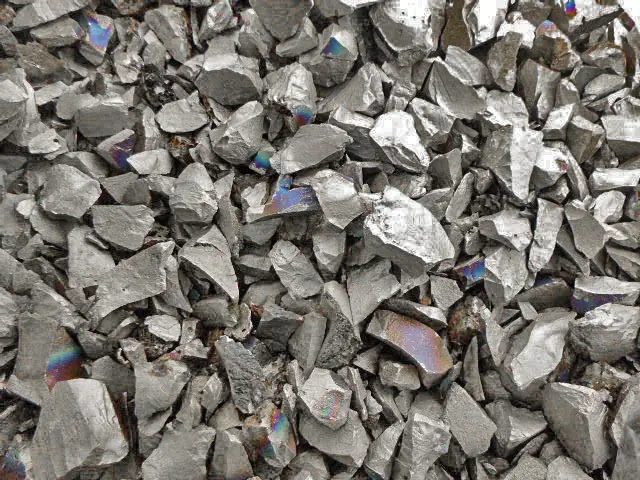
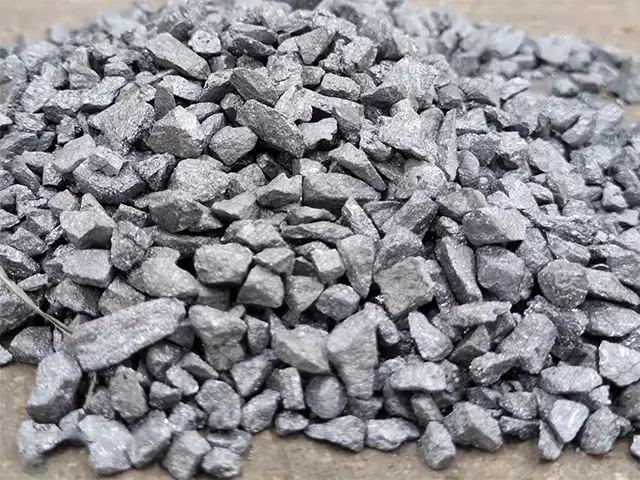
Our products are available in several grain sizes to satisfy different addition methods: furnace, ladle, in-stream, or in-mould.
Our technical experts help select the specific ferrosilicon-based product for your unique application and foundry process.
Product Forms
Quality Assurance
Our inoculants production is governed by strict ISO 9001 :2015 protocols, with meticulous monitoring from raw material to final packaging.
Strict control of active elements (Ba, Sr, Ca) is maintained through regular spectrometer analysis.
Particle size distribution is verified with laser particle analyzers to ensure effective dissolution and inoculation.
Infrastructure
For inoculants, we utilize induction furnaces and a controlled crushing process to achieve tight size specifications.
Packaging is conducted in a moisture-controlled environment, with options including waterproof bags and steel drums.
Metallurgy
Inoculation creates nucleation sites for graphite precipitation. This prevents undercooling and the formation of carbides or "chill".
The effectiveness of an inoculant depends on its active elements. Ba offers fade resistance, Sr is a powerful graphite promoter, and Zr refines structure.
Proper inoculation results in a homogenous microstructure, which improves machinability, tensile strength, and casting consistency.

ISO 9001 :2015 CERTIFIED QUALITY SYSTEM
All production batches are tested in-house to ensure consistent chemical and metallurgical parameters.
Explore Other Products
Discover our full range of high-performance metallurgical solutions.
Applications by industry
How this alloy is used across the verticals we ship to in India and globally.
Automotive
Grey iron brake discs and ductile iron crankshafts both depend on reliable inoculation — matrix control is what eliminates chill at thin sections and unwanted carbides at heat-affected zones.
Agriculture
Tractor housings, gear cases and hydraulic blocks in SG iron need consistent nodule count and matrix structure; in-stream and in-mould inoculation hold that consistency batch-to-batch.
Railways
Brake blocks, draft gear and pipe fittings — grey iron and SG iron — rely on inoculants for predictable hardness, machinability and absence of carbides at section changes.
Wind
Heavy SG iron hubs and main frames need high nodule count uniformity across very thick sections — Ba- and Zr-bearing inoculants resist fade and stabilise the structure through long solidification times.
Water & Pipeline
Centrifugally cast ductile iron pipe relies on Sr- and Ba-based late inoculants to suppress carbides and meet pressure-class strength specifications.
Frequently asked questions
Common questions about Inoculants. For specification-grade enquiries, please request a technical sheet via the documents block above.
What is a foundry inoculant?
A finely sized FeSi-based alloy added to liquid grey or ductile iron just before pouring. It creates micro-nucleation sites for graphite, suppresses chill (carbide formation) and delivers a consistent, machinable microstructure independent of section thickness.
When is the inoculant added — furnace, ladle, in-stream or in-mould?
All four routes are used. Ladle and tundish-cover are the most common; in-stream and in-mould are reserved for thin-section castings where late, fast-acting inoculation is required. Our BBIN family covers all four addition methods.
What active elements matter and why?
Calcium gives baseline nucleation. Barium gives fade resistance — critical for long pouring sequences. Strontium is the strongest graphite promoter at low addition rates and suits in-stream/in-mould. Zirconium refines structure and ties up tramp nitrogen.
What particle sizes do you supply?
Sizes from 0.2–0.7 mm fines (for cored wire / in-mould) through 0.7–3 mm and 2–6 mm to 10–25 mm lumps for furnace charging. Custom screens are standard.
How long do inoculants stay effective in storage?
Sealed in original moisture-resistant packaging, in a dry covered area: up to 12 months. Once opened, use within 90 days. Fines (under 0.7 mm) are more sensitive to moisture and should be used quickly.
How do I pick between BBIN-2070 and BBIN-3858?
BBIN-2070 is a high-Si Ca-bearing baseline inoculant for general grey-iron use. BBIN-3858 adds Ba+Sr for fade resistance and stronger graphite promotion — preferred for SG iron and longer pour cycles. Our team helps match grade to your specific melt practice.
Can you formulate a custom inoculant?
Yes. We routinely produce custom Ba/Sr/Zr/Ca/RE balances on the same induction route. Trial bag (25–500 kg) qualification orders are supported with technical service from our metallurgical team.