

India's foundry market is forecast at a 15.6% CAGR through 2030, with absolute sector size projected at USD 42.5 billion by 2029 (Bharat Foundry 360° via ANI; Technavio India foundry analysis). Within that growth, ductile and compacted-graphite iron are taking share from grey iron, driven heavily by EV localisation. India's electric vehicle sales in April 2026 reported passenger EV growth of 75.14% and two-wheeler EV growth of 60.73% year-on-year (IBEF EV industry data), and the bill of materials behind those vehicles is castings-heavy: suspension knuckles, brake discs, motor housings, battery-pack structural elements.
Behind that demand, the regulatory floor has also moved. India's Bureau of Indian Standards now mandates magnesium content consistency within ±0.5% and silicon within ±1% on imported nodularisers (PW Consulting nodulizer market review). The qualification bar for cheap imported FeSiMg has risen materially. For an Indian foundry switching from agri-tractor grey iron to EV-segment ductile iron, the alloy decision now also carries a customer-side compliance dimension.
What the alloy actually does
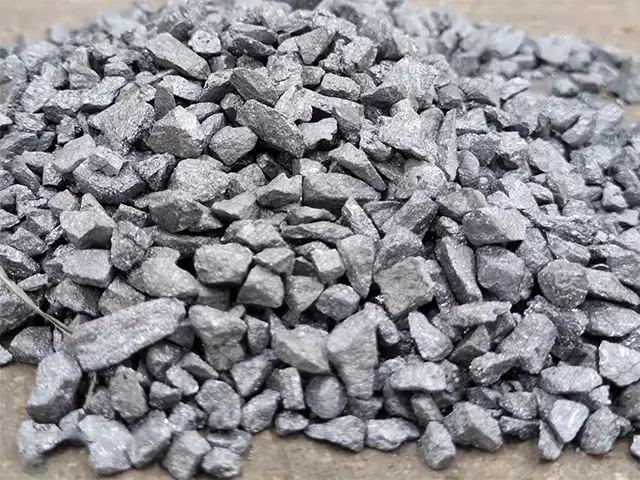
Ferro Silicon Magnesium injects controlled magnesium into the melt so that graphite precipitates as spheroidal nodules instead of flakes. The metallurgical consequence is large: tensile strength rises 3–5×, fatigue life improves materially, and the casting moves from grey-iron territory (brittle, cheap, high damping) into ductile-iron territory (high strength, ductile, used anywhere mechanical loading matters). The grade choice within FeSiMg controls how predictably that transformation happens at scale.
Use case 1 — heavy SG-iron sections (EV knuckles, hubs, wind hubs)
A 6–7% Mg FeSiMg grade is the default for traditional sandwich-pocket treatment of light- to medium-section grey iron. When sections grow heavier and cooling times stretch — EV suspension knuckles, heavy-duty truck wheel hubs, wind-turbine main hubs — magnesium fade extends past the window where 6–7% grades sustain nodularity. Higher-Mg grades are formulated for exactly this class of part: BBMAG 901010 at 9.0–9.5% Mg, BBMAG 952525 at 9.0–10.0% Mg. Residual Mg in the casting holds above 0.035% for longer, nodule count stays within drawing requirement, and the part comes out within mechanical-property spec on first run.
Use case 2 — sandwich treatment with stable Mg recovery
Sandwich and tundish-cover treatment routes lose substantial magnesium to reaction flare and burn-off. The calcium content of the FeSiMg directly controls how soft that reaction is and how much Mg ends up in the metal versus in the slag. Calcium-rich formulations like BBMAG 380810 (3.5–4.0% Mg, 0.8–1.2% Ca) and BBMAG 630515 (6.0–6.5% Mg, 1.3–1.7% Ca) are specifically designed for ladle-stage addition. Drop the same grades into a cored-wire late-stream setup and the calcium ratio matters less; in an open ladle it is the difference between Mg recovery in the high-30s and Mg recovery in the low-50s percent.
Use case 3 — partly-recycled charge with tramp elements
Indian foundries running on partly recycled scrap inevitably pick up antimony, lead, bismuth and titanium. Above material-specific thresholds, all of these interfere with graphite spheroidisation and destroy nodularity even when the Mg number reads right. Rare-earth additions in the FeSiMg neutralise these tramp elements. Lanthanum-bearing misch-metal grades — BBMAG 630520 La and BBMAG 630533 La — carry 0.4–0.6% La specifically for this scenario. For pipe foundries, automotive secondary smelter feedstock and any foundry that has inherited variable scrap chemistry, RE-bearing grades are no longer optional.
How to read the grade label
The BBMAG numbering is a packed code: the first two digits are nominal Mg, the next two are nominal Tre (total rare earth), and the last two are nominal Ca. BBMAG 630515 therefore parses as 6.0–6.5% Mg, 0.4–0.6% Tre, 1.3–1.7% Ca. Once the foundry side knows their section thickness, their treatment method and their charge cleanliness, the alloy decision is mostly a matter of matching those three coordinates against the BBMAG range.