
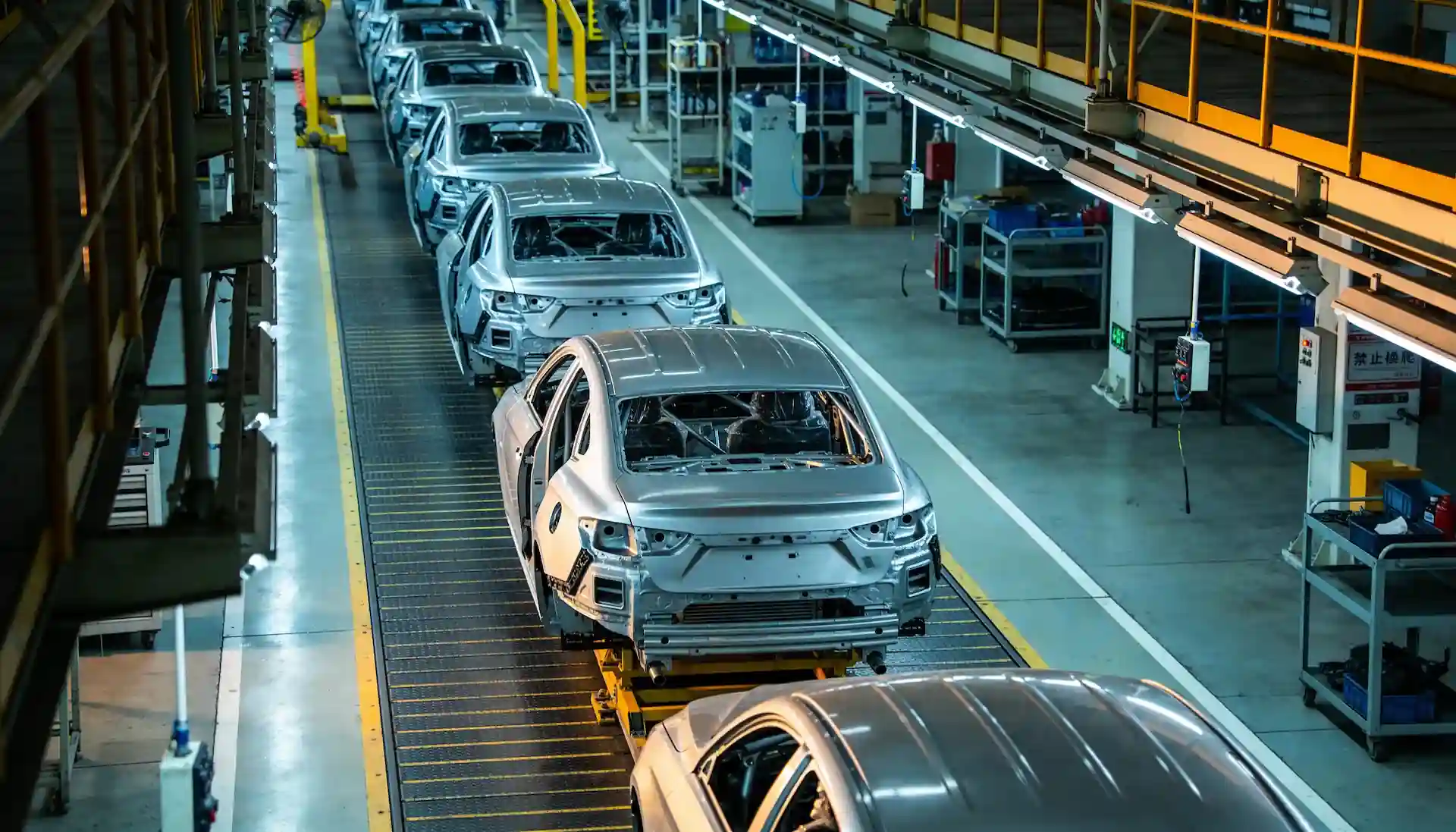
India's electric vehicle sales reported sharp acceleration in April 2026: passenger EV sales rose 75.14% year-on-year and two-wheeler EV sales rose 60.73% (IBEF EV industry data). That pull is showing up directly in the country's stainless steel consumption profile, which is the fastest-growing among major economies at a 6.2% forecast CAGR through 2035 and on track to almost double from USD 18.5 billion (2025) to USD 33.8 billion by 2035 (Stainless Today; KnowledgeRidge industry analysis).
The shift inside stainless consumption matters as much as the headline volume. EV-specific stainless applications skew toward higher-spec grades — battery housings in grade 444 (titanium- and niobium-stabilised ferritic), exhaust and thermal-management hardware on hybrids, structural and chassis applications in duplex grades. Aerospace-grade and super-duplex grades carry a 20–30% price premium over standard 304/316 (Discovery Alert ISSDA analysis), which sustains the metallurgical specialisation the supply chain needs.
EV-specific stainless applications
EV vehicle bills-of-materials drive different stainless usage than internal-combustion equivalents. The biggest shifts are in three places: battery-pack structural enclosures (which prefer ferritic stainless for weight and corrosion resistance), thermal-management plumbing (duplex grades for pressure rating in cooling loops), and electric-motor housings (high-purity ferritic for magnetic permeability where motor topology requires it). All three applications value titanium-stabilised chemistry: 444 for the ferritic structural cases, 316Ti where austenitic corrosion resistance is required, and specialised duplex grades for cooling circuits.

What it means for Ferro Titanium consumption
Ferro Titanium consumption per tonne of finished stainless is higher in the grades EV applications are pulling on than in commodity 304. Grade 321 uses titanium at roughly 5× the carbon content; grade 444 uses Ti + Nb combined stabilisation; 316Ti carries Ti at lower addition than 321 but to the same end. As Indian stainless production mix shifts toward these stabilised grades — both because EV applications require them and because PLI scheme incentives explicitly reward them — the FeTi tonnage required per million tonnes of finished stainless rises faster than the headline stainless growth rate suggests.
Domestic ferro-alloy producers with grade range from BB-30 (28–32% Ti) for cost-sensitive deoxidation through BB-70 (68–72% Ti) for aerospace-grade applications are positioned for the mix shift in a way commodity-grade producers are not.
What it means for Ferro Silicon Magnesium consumption
The same EV pull translates downstream into ductile iron demand: brake discs, suspension knuckles, motor housings, battery-pack structural elements. India's cast iron output grew 8.3% in FY23 (PW Consulting) and the foundry sector is on a 15.6% CAGR through 2030 (Technavio). For Ferro Silicon Magnesium, that means heavier consumption of higher-Mg grades (BBMAG 901010, 952525) and rare-earth-bearing grades (BBMAG 630520 La, 630533 La) for the EV-segment casting work where section profiles and chemistry tolerances both tighten.