
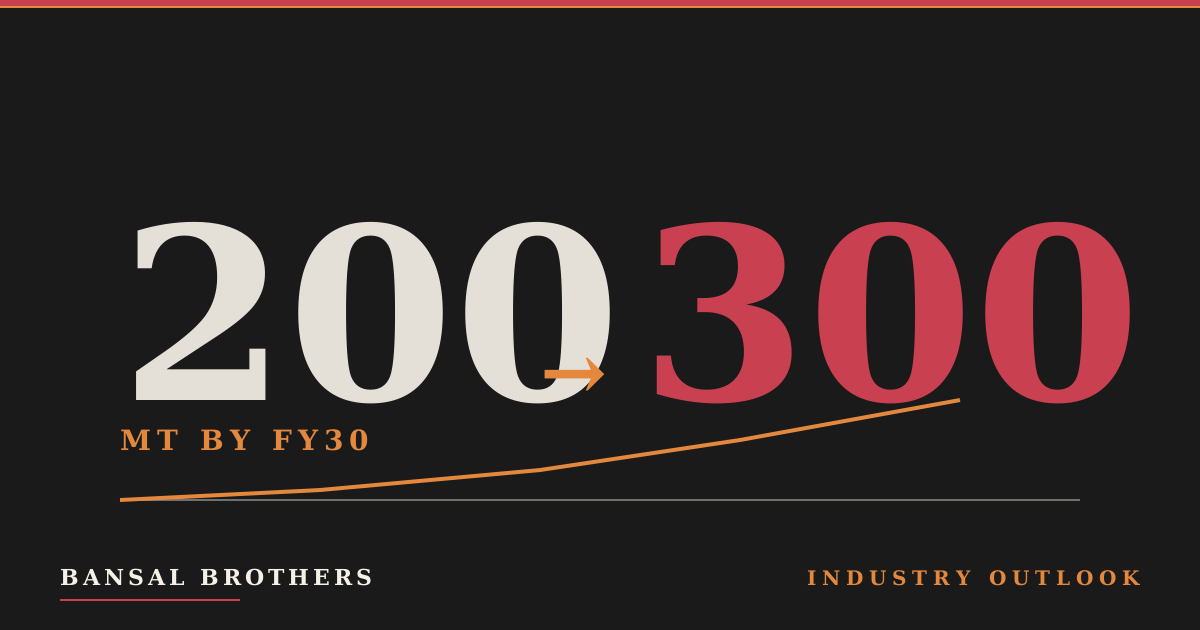
India installed steel capacity reached 200.33 MT in FY25 and the National Steel Policy trajectory calls for 300 MT by FY30 — a 50 percent absolute lift in five years against a global backdrop of flat or declining capacity in the EU and parts of Northeast Asia (Ministry of Steel; IBEF; IndexBox 2026 forecasts). The headline number is a useful demand anchor for capital planning. The grade mix inside that capacity is where the ferro-alloy demand math actually lives.
The mix shift through 2026 to 2030 is policy-led. The PLI scheme for specialty steel explicitly incentivises titanium-stabilised, aerospace, defence, electrical and high-strength-low-alloy grades — categories India was previously importing. The implicit policy goal is a higher specialty-grade share in the domestic mix by FY30, with knock-on consequences upstream.
The grade-mix arithmetic
Current specialty-grade share of total Indian steel output sits at roughly 25 percent, with commodity HSLA, structural, plate and rebar making up the remainder. PLI-tied capacity additions push the specialty share toward 40 percent by FY30 on most analyst forecasts. That means total Indian specialty-grade output rises from about 50 MT today to about 120 MT by FY30, more than doubling in absolute volume against an underlying steel capacity that grows 50 percent.
Within specialty, the highest-Ferro-Titanium-intensity sub-categories are the titanium-stabilised austenitics (321, 316Ti), the ferritic 444 used in EV battery housings, and the duplex grades used in oil-and-gas and cooling-circuit applications. Each MT of grade 321 stainless consumes roughly 1.6 kg of FeTi at the practical mill addition rate. Ferritic 444 with Ti-Nb stabilisation consumes a similar amount.
What the FeTi demand math implies
Naive arithmetic: 70 MT per year of incremental specialty-grade output (versus current) times approximately 1.5 kg FeTi per MT averaged across the grade families equals roughly 105,000 MT per year of incremental Ferro Titanium demand by FY30. That is on top of demand from the underlying capacity growth. Even allowing for grade mix variability, the second-derivative growth in FeTi demand is sharply higher than the headline steel capacity growth.
The picture for Ferro Silicon Magnesium is similar but stretched out — much of the downstream pull comes through the foundry sector (separately on a 15.6 percent CAGR) rather than direct steel consumption. The picture for foundry inoculants follows the foundry growth curve.
Three things this changes about producer planning
First, contract horizons. PLI-recipient steel customers are writing supply contracts on longer durations than the spot-and-quarterly pattern that has dominated Indian ferro-alloy trade. Producers operating with multi-month inventory positions are positioned for this regime; spot-arbitrage operators are not.
Second, grade-customisation capability. The customers driving the next decade of demand growth do not want commodity-grade FeSi — they want chemistry-controlled grades inside specific Ti, Al and C bands. Production routes that can hold those bands tightly (induction-furnace production with three-checkpoint chemistry control) are the operational answer.
Third, audit and traceability discipline. The downstream-customer audit requirements that used to apply only to aerospace customers in Toulouse or Seattle now apply to specialty stainless customers in Bengaluru and Mumbai. ISO 9001:2015 documentation discipline is becoming an entry condition, not a differentiator.