

India's foundry industry is forecast to reach USD 42.5 billion by 2029 (Bharat Foundry 360° via ANI) on a sector CAGR of 15.6% through 2030 (Technavio). Inside that growth, ductile and compacted-graphite iron applications are taking share from grey iron — EV brake discs and knuckles, wind-turbine hubs, agricultural-machinery castings, railway brake components, ductile-iron pipe — and all of them are driving demand for specialty foundry inoculants rather than commodity ferrosilicon.
Inoculants are added in small quantities, typically 0.1–0.6% of melt weight, and they determine whether a casting solidifies clean or with chill defects, whether graphite forms predictably, and whether the resulting microstructure meets mechanical-property spec on the first run. The cost of a poorly-selected inoculant is paid in scrap rate, not in alloy price.
What inoculation actually does
Inoculants provide nucleation sites for graphite precipitation during solidification. Without sufficient nucleation, the liquid iron undercools below the stable graphite eutectic and the metastable carbide eutectic takes over — producing chill (white iron, hard, brittle, unmachinable) at the casting surface or at thin sections. Effective inoculation suppresses chill, refines graphite morphology, and produces a homogeneous matrix that machines and performs consistently across the casting cross-section.
The four active elements
Calcium — baseline nucleation
Calcium is the primary active element in almost every inoculant. It is fast-acting and produces rapid nucleation, but it fades quickly — typical effective nucleation drops sharply within 6–8 minutes of addition. For short pour cycles and heavy-section grey iron, calcium-only inoculants like BBIN 2070 (Si 70–75%, Ca 0.8–1.2%) are the cost-effective baseline.
Barium — fade resistance
Barium extends effective nucleation from 6–8 minutes to roughly 12–15 minutes. For long pour cycles, heavy ductile-iron sections that solidify slowly and any process where ladle-to-mould transfer time is variable, barium-bearing inoculants are the safety margin. The BBIN range covers this with BBIN 566 (Ba 2.0–3.0%, with Ca for baseline nucleation), BBIN 38 (Ba 0.8–1.2% paired with low-Ca high-Si chemistry) and BBIN 3858 (a triple- active grade combining Ba and Sr).
Strontium — strongest graphite promoter at low addition
Strontium is the most potent graphite-promoting element used commercially. Even at low addition rates (0.10–0.20% of melt) it produces dense, uniform graphite distribution and effectively prevents chill at thin sections. The trade-off is short residence — Sr drops off faster than Ba — which is why Sr-bearing grades are most commonly paired with in-stream and in-mould application where the time from inoculation to solidification is measured in seconds. For thin-section grey iron components (radiator grilles, automotive brackets, pump housings), Sr in the in-mould chamber is usually the right answer.
Zirconium — grain refinement and N control
Zirconium does two things at once: it refines grain structure and it ties up tramp nitrogen that would otherwise interfere with solidification. Foundries running a high-nitrogen steel scrap fraction in the charge — and that is increasingly common in India as scrap economics shift — should consider Zr- bearing grades like BBIN 3840 (Zr 1.0–1.5%) or BBIN 562540 (multi-active Ba+Sr+Zr+Mn) at least as part of a multi-stage inoculation strategy.
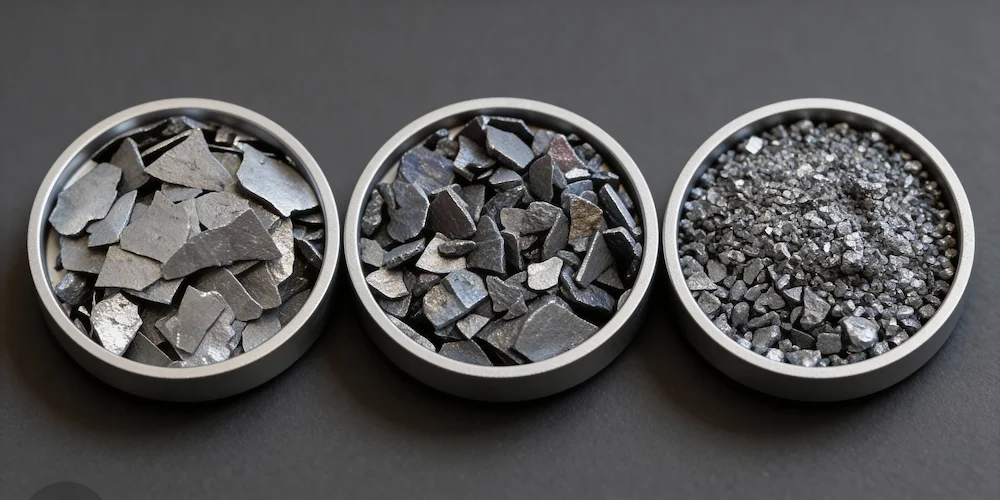
Addition method matters as much as chemistry
Inoculant addition happens at four points in the melt-to-mould chain, each with its own residence-time profile and grade implication:
- Furnace addition — long residence, severe fade. Use Ba-bearing grades and accept the conservatism.
- Ladle (sandwich, tundish-cover, plunging) — typical Ca + optional Ba for fade resistance. The most common point of addition for traditional foundries.
- In-stream (during pouring) — short residence, can use Sr-strong grades for thin sections. Requires reliable dosing equipment.
- In-mould (reaction chamber in the runner system) — shortest residence window, highest impact per addition. Sr-bearing grades excel here; particle size critical (0.2–0.7 mm typical).
A grade selection short-list
For practical foundry purchasing in 2026, the BBIN range maps as follows:
- BBIN 2070 — high-Si Ca baseline. Grey iron, traditional applications, short pour cycles.
- BBIN 566 — Ca + Ba, fade-resistant. Heavy-section ductile iron, long pour cycles.
- BBIN 3858 — Ca + Ba + Sr triple-active. EV-segment ductile iron, demanding mixed-section work, in-stream addition.
- BBIN 3840 — Ba + Zr. Charges with high-N scrap contribution.
- BBIN 562540 — multi-active (Ba + Sr + Zr + Mn). Specialty applications, technical-buyer foundries.